
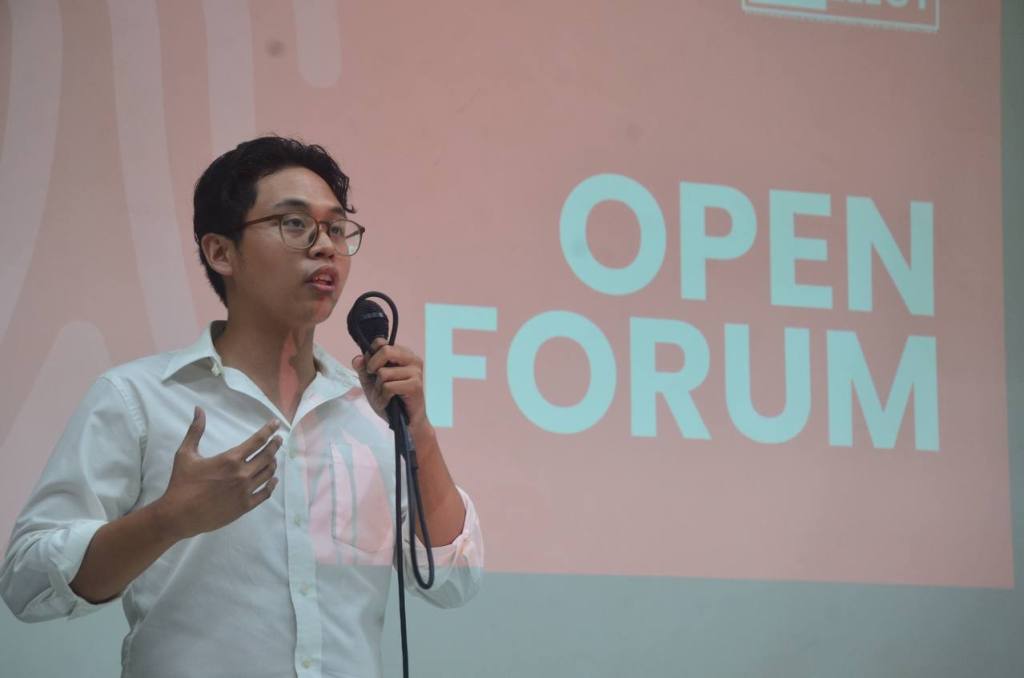

Isinagawa ang panayam kay Ethan Pahm sa Student Union Building noong Biyernes, Mayo 10.
INTERVIEW GUIDELINES
1. Maaaring gawin ang panayam nang face-to-face o online, depende sa mapag-uusapan ng Tanglaw Editorial Board at nangangandidato.
2. Ang panayam na ito ay ididirekta sa buong partido, at nasa partido ang desisyon kung sino ang sasagot sa kada tanong.
3. Mayroong sampung (10) tanong na saklaw ang mga laganap na isyu sa sa loob ng kolehiyo, at apat (4) na bukod na tanong patungkol sa karakter at mga isyung nakabunton sa pangangandidato ng mga tumatakbo.
4. Bibigyan ang nangangandidato ng dalawang (2) minuto upang sagutin ang bawat tanong.
5. Ang magiging sagot sa panayam ay pinal at hindi na kikilalanin ng pahayagan ang anumang paglilinaw matapos masagot ang isang tanong.
DAPAT MONG MALAMAN
Pindutin ang tanong upang dumiretso sa buong transcript ng naging sagot ng mga kandidato.
General Questions
“I held the position of external head in UPSILON SIGMA PHI but I’ve since left that office and left that position in order to make sure that I have enough time to be able to properly focus on the student and constituents of CDC […] Not only that, I think it’s also very well-known that I don’t have any other org aside from that […] So, I think our constituents can be confident in knowing that I have more than enough time, next to my studies of course ‘cause we’re all students, to be able to work with my responsibilities in the CDC SC”
“Some of the things I’m already planning to do is to make sure that we keep a very open dialogue with orgs. But not just with orgs, but also students who don’t have this kind of affiliations to make sure that they are still heard; and to also make sure that we keep an open contact not just with students but also with professors and from the mga departments […] Also, the dissemination of forms, regular discussions, focus group discussions, and consultative sessions to make sure that all aspects of CDC are well-represented.”
“For me, the number one priority really is currently, the heat wave […] Under my job description as Representative to the USC, we can be able to work with more cohesive academic policies on whether we should be delaying or asking for better budget from the government, for one thing, to be able to properly house our students, provide better facilities. For example, one thing that we’ve already been doing and I hope we can continue with working with is that some of our classrooms have been repurposed as LRCs. […] But in the long term, of course, it’s under my platform where I want to promote sustainability and be able, at least on the small scale, something individuals can do in order for us to at least combat climate change and its effects on the college”
Q: Ano ang mga pina-prayoridad mong panawagan sa iyong pangangampanya?
“One of biggest priorities is to be able to create a very sustainable solution to students and professors suffering under the current heat wave and the unexpected changes it’s had on our semester and the way it’s affected students’ studying because of course, we’ve had this sort of thing before, at least an external factor, making the students have to go through whether online class or hybrid [set up]. But of course these aren’t… there’s no one size fits all solution to this sort of thing, especially with the heat wave […] But also aside from that, it’s also been something that I am very vehemently campaigning for, […] to make sure that there’s a rigorous system in place to make providing suggestions, providing ideas to the college very accessible and very easy.”
“For me, the current student council based on what I’ve observed already, they’ve been working on, well, let’s just say the heat wave wasn’t really something that they were prepared for since this is near… a project near ending their term […] Of course, with the ongoing heat wave I would continue the projects of temporarily turning classrooms into learning resource centers for students first so that they can rest with airconditioning in the meantime. What would I also do? Make it so that there’s very easy dialogue. […] I would make sure that there’s a bigger petition or bigger focus on students and their professors but mainly on the issue of inconsistencies between learning systems”
“We need to be able to properly defend press freedom and make sure they’re unrestricted in being able to report developmental news, news in general, and being able to report on genuine issues and shortcomings, or possibly even victories inside the college and even inside the campus. Now, as for the relationship of Tanglaw with the University and the Student Council, Tanglaw, of course, serves as yet another avenue for students to be able to understand current events, what’s going on, and relevant information; and what they need to know as students of UP in order for them to get the most out of their college experience and in order for them to be aware of genuine social issue”
“There’s a saying that I like to use, “we work with communities, not at them”. Of course, it’s not always the most appropriate description, but for me this is the one that stuck in my head because in the current political climate of the Philippines, it’s very common for charity to be a thing. Politicians will often give charity or a lot of programs will be focused around charity for communities that are in need of well, need to be developed. As Devcom students, and us Development Communicators, we try to uphold a better approach to charity. We make it so that charity isn’t just a one time thing pangphoto-op, but rather we make it so that this sort of charity is sustainable. It’s not just one thing but it’s genuine skill development so that they no longer will have to rely on this charity, but rather they’ll already have the tools, the skill set, and the knowledge to be able to help themselves, to uplift themselves so that they’ll never have to rely on charity again.”
“Student councils also have that responsibility to be able to uphold this idea wherein we don’t just serve the students but we also go out of our way to be able to make sure that our students are aware of these issues and we openly encourage them and give them opportunities through basic mass integration, for one, and outreaches and immersions to be able to actually implement that knowledge and show them the reality of what’s its like in these marginalized sectors or marginalized people. So that for one, when they finally have their careers, they know the proper direction which they might need to go in order to help these marginalized sectors.”
“We are an example […] We represent what UP students can really do in terms of activity, activism and it’s through this when we work with our peers in order to inspire them and encourage them to work with us and encourage them to take the same action as we do when we go out and promote our praxis and activism through the streets, through our basic mass integrations, and such. Not only that, but it’s also our responsibility in the Student Council to keep the discourse with the professors to encourage them to teach their students not just through the classroom setting but through unique programs and by attending seminars through things like, the incentives.”
“One of the things that I wanted to address was to be able to create projects under the college, projects under Devcom, that don’t simply fall under one department but rather are projects that have all of the departments being able to work hand-in-hand […] At the end of the day, when we finish the course that ends with “DC”, whether that’s AS or BS, we’re still going to be inculcated with the same kind of mindset of “for the masses, for true and genuine developmental change”. So, when we have more projects that fall under all of the departments, it will be able to focus more on the praxis rather than the theory to be able to show that the end result is the same and show that while the methods are different, these two aren’t so different after all […] It’s this mindset that’s taught universally and I think this will be the bridge between the gap between the two.”
Party-specific Questions
“There was a bit of conflict of interest regarding my affiliation […] I found it in my best interest to be able to respect the decision of my other slate members […] I felt it was necessary for me to withdraw and be able to work with my own party under independent. It really is simple as that and I felt that, regardless of party, I still felt like the priority was always the constituents of CDC, the students.”
“I felt like I wanted to be able to focus more on the effects of climate change and things we could do to be able to combat them. See, as my background is previously Electrical Engineering before I shifted, I always wanted to be able to work on renewable energy and sustainability and now as a CDC student, I want to be able to implement this sort of focus on sustainability, at least on the small scale […] That would be something that’s different from SAKBAYAN—this renewed focus on sustainability and addressing the heat wave directly. […] I just want to be able to clarify that even under SAKBAYAN, I still want, I always wanted to make sure that every CDC student had a voice and is well-represented in the university at large.”
“It’s always been my conviction to say that I have never been afraid to criticize the organization that I am part of. If in my eyes I see that the UPSILON SIGMA PHIi has done something unforgiveable and something that’s not right, I have always been there to fight against it […] I’ve always made it very clear that my stance against frat-related violence is that it’s antiquated and completely unnecessary practice that should never be repeated as much as possible and Fraternities should always be held accountable for any sort of cases relating to frat-related violence […] I, myself, was one of the people working with the student disciplinary tribunal to be able to help file cases properly and be able to file reports properly, which is I would say an indicator to show that I’m really against FRV.”
Q: Kung sakaling ikaw ay hindi palarin, paano ka magsisilbing watchdog ng mga mauupo sa pwesto?
“Win or lose I will always try to strive to achieve my objective of being able to work with the constituents, whether that be from working alongside them or being in the position of the student council. I would attend EDs as much as possible whether or not I have affiliation with them […] I would focus on being able to make myself more knowledgeable about issues to be able to properly speak out against them. I have social media for a reason to be able to communicate […] to speak with campus press, organizations, make sure that my voice is heard just as much as a constituent; and be very vocal about the social issues happening in the community and of course as a fratman […] I will admit here, I have special connections that aren’t available to most and it would it be very irresponsible of me not to be able to utilize these connections to be able to work with the system, to be able to see the social change that I would like to see in the college, and in the community, and the university.”
TRANSCRIPT NG PANAYAM
GENERAL QUESTIONS
TANGLAW: Batid namin na aktibo ka sa iba’t ibang mga organisasyon at kasabay rin nito ang ating responsibilidad bilang mga estudyante. Paano matitiyak ng mga mag-aaral ng Devcom na magagampanan mo ang iyong tungkulin sa konseho?
PAHM: In my case, I think it’s well-known and also for transparency to the constituents of Devcom [Development Communication] that I am in a fraternity, not just any but UPSILON SIGMA PHI. In order to prepare for my candidacy, not just for my campaign, but in order to be able to properly run from office, previously, I held the position of external head in UPSILON SIGMA PHI but I’ve since… left that office and left that position in order to make sure that I have enough time to be able to properly focus on the student and constituents of CDC. Not only that, I think it’s also very well–known that I don’t have any other [organization] aside from that, even if I do have some connections to some orgs [organizations] from Ateneo. But also rest assured there that I’ve only ever really kept in contact but haven’t held an executive position in those orgs either. So I think, our constituents can be confident in knowing that I have more than enough time, next to my studies of course ‘cause we’re all students, to be able to work with my responsibilities in the CDC SC [College of Development Communication Student Council].
Pindutin ito para bumalik sa mga tanong.
TANGLAW: Paano mo masisiguro na magkakaroon ng sapat na representasyon ang mga estudyante sa pagdedesisyon ng UPLB o CDC administration?
PAHM: Well, in my case of course it’s on the job description as College Representative to make sure that every voice from CDC is heared. And as you heard earlier, you personally were there from my campaigning from classroom to classroom, it’s one of the things that I vowed for very vehemently and practically speaking some of the…some of the things I’m already planning to do is to make sure that we keep a very open dialogue with orgs but not just with orgs, but also students who don’t have this kind of affiliations to make sure that they are still heard; and to also make sure that we keep an open contact not just with students but also with professors and from the mga departments whether that be from Edcom [Educational Communication], from DD [Department of Development] Broadcasting, from DDJ [Department of Development Journalism]—things like that as I’ve already had a background in some of them and it’s kind of my job to make sure that there’s not just open communication, but also the dissemination of forms, regular discussions, focus group discussions, and consultative sessions to make sure that all aspects of CDC are well-represented. Not just the students, not just the orgs, but also the professors and everything in between.
I want to make sure that everyone gets a voice. I want to be approachable. I want to, well assuming I win, of course, I want the whole council to be able to be approachable. If there’s an issue, even something as small na ang init sa… ang init sa building or this room has broken projector, I want it to be able to be diretso sa amin regardless of who we are, from vice [chairperson], councilor so that we can tell the USC [University Student Council] if it’s a problem for the USC or we can resolve it among ourselves.
Pindutin ito para bumalik sa mga tanong.
TANGLAW: Ano ang nakikita mong isyu sa kolehiyo na humahadlang sa pang-akademikong kalayaan at paano mo ito matutugunan?
PAHM: This is something I’ve been very transparent with in terms of my platform. In terms of threats towards academic freedom inside the college, for me the number one priority really is currently, the heat wave. I’m sure there’s been so many students regardless where they’re dorming, whether it’s from Forestry or in my case, I stay in Agapita. It’s a 10-minute walk from my apartment all the way to college and in that 10-minute walk I feel like I’m in an oven. I bake so I would know. So, it’s this heat wave that’s a threat to our academic freedom because it [inaudible] from one thing—focusing. But it also focus… it also affects the professors. Our professors have been so hesitant in…or most of the time they’re hesitant to make… to announce na whether there’s class or not, whether its asynch [asynchronous], synchronous or not, which is probably one of the reasons why they’re going to have a strategic planning in the upcoming week. I asked some of them myself. So, what’s something that we can do to address this heat wave? For one, we can be… under my job description as Representative to the USC, we can be able to work with more cohesive academic policies on whether we should be delaying or asking for better budget from the government, for one thing, to be able to properly house our students, provide better facilities. For example, one thing that we’ve already been doing and I hope we can continue with working with is that some of our classrooms have been repurposed as LRCs [Learning Resource Centers]. I can see, I’ve been to the classrooms and many of the students are very happy, working under the airconditioned classrooms, for one and I hope we can develop a more comprehensive version of that system since definitely, this is only the start. This is just a temporary solution to a very wide issue that isn’t something that doesn’t seem to be going away anytime soon, especially with climate change, which is also a very big part of my platform—sustainability. But in the long term of course, it’s under my platform where I want to promote sustainability and be able, at least on the small scale, something individuals can do in order for us to at least combat climate change and its effects on the college.
Pindutin ito para bumalik sa mga tanong.
TANGLAW: Ano ang mga pina-prayoridad mong panawagan sa iyong pangangampanya?
PAHM: As related to the previous question, one of biggest priorities is to be able to create a very sustainable solution to students and professors suffering under the current heat wave and the unexpected changes its had on our semester and the way its affected students’ studying because of course, we’ve had this sort of thing before, at least an external factor, making the students have to go through whether online class or hybrid [set up] but of course these aren’t… there’s no one size fits all solution to this sort of thing, especially with the heat wave. I think it would be very short-sighted to say, to tell students to simply just suck it up and endure going to class under this sort of heat but that’s for me. That’s my number one priority and once that’s addressed, we can work towards making the college more sustainable in other ways… in the small scale as well for us as a college, such as if I were to give some example, more comprehensive waste management system or fundraisers so that we could be able to potentially invest in solar panels for the top of the building but that’s already for a long term process.
But also aside from that, it’s also been something that I am very vehemently campaigning for is that, while yes, these are priorities of mine, but it also falls under my job description as a College Representative is to make sure that there’s a rigorous system in place to make… providing suggestions, providing ideas to the college very accessible and very easy. Not only that, make it so that it’s not just very segmented. For example we have project its usually under DDJ, usually its under Scicomm [Department of Science Communication], but to be able for students to work with all of the departments under Devcom, if that makes much sense. To be able to work together with one another to make projects that are more united under one Devcom banner, if that makes any sense.
Pindutin ito para bumalik sa mga tanong.
TANGLAW: Kung may pananatilihin o babaguhin ka sa naging pamamalakad ng kasalukuyang Student Council, anu-ano ito at bakit?
PAHM: For me, the current student council based on what I’ve observed already, they’ve been working on, well let’s just say the heat wave wasn’t really something that they were prepared for since this is near…a project near ending their term and the current student council was elected at a time where face-to-face classes were…I wouldn’t say in its infancy but we’re already in the second or third phase already. So, what would I do in order to improve on some of these policies? Of course, with the ongoing heat wave I would continue the projects of temporarily turning classrooms into learning resource centers for students first so that they can rest with airconditioning in the meantime. What would I also do? Make it so that there’s very easy dialogue. Make it… I would make sure that there’s a bigger petition or bigger focus on students and their professors but mainly on the issue of inconsistencies between learning systems, right? You know how some classes they use Google Classroom, other students, they use Canvas. But the thing is sometimes when they use Canvas it’s not even consistent because they need to make an entirely different account. I think this is one that we could really prioritize to make students…well, the academic experience more consistent between classes; and work with the professors and teachers and the faculty in order to make sure that it’s just simpy one so that students don’t get confused.
Pindutin ito para bumalik sa mga tanong.
TANGLAW: Bilang mga development communicators, ano ang pagtingin mo sa press freedom? Sa lebel ng ating kolehiyo, ano ang nakikita mong relasyon ng Student Council at ng bagong-tatag na Tanglaw?
PAHM: Well, Press Freedom… well for one, to state the obvious we already have our Department of Developmental Journalism so of course, we need to be able to properly defend press freedom and make sure they are…they’re unrestricted in being able to report developmental news… news in general and being able to report on genuine issues and shortcomings or possibly even victories inside the college and even inside the campus. Now, as for the relationship of Tanglaw with the University and the Student Council, Tanglaw of course serves as yet another avenue for students to be able to understand current events, what’s going on, and relevant information; and what they need to know as students of UP in order for them to get the most out of their college experience and in order for them to be aware of genuine social issues, for one, that’s going on. For example, if the student council makes a decision, students have the right to know about it, whether they disagree with it or not. And it’s through news institutions like this, both Perspective, Tanglaw, and any further ones that might come along. For example, the one that might be [inaudible] in CEM. They… not only do they provide a platform for information to be heard but they also provide a platform for feedback from the students to also be heard to these student councils. Like, let’s say there’s a situation where student…where the student councils make a questionable decision. Of course, there’s going to be student backlash on social media and so on and so forth, and by that time it’s going to be the responsibility of news student institutions, such as Tanglaw, to be able to report on it and let the student councils know that clearly they made a mistake and they should do something in order to address it.
Pindutin ito para bumalik sa mga tanong.
TANGLAW: Sa kasalukuyang kalagayan ng ating lipunan, ano ang nakikita mong papel nating mga development communicators?
PAHM: Of course as a Devcom student myself, this is something that we very much have studied plenty in the earlier… in the earlier Devcom courses and they serve as the fundamentals for our career and our career path moving forward. Of course, there are key guidelines in order…such as being able to genuinely understand the communities we work with to be able to use the participatory method in order to uplift communities, not help them. There’s a saying that I like to use, “we work with communities, not at them”. Of course, it’s not always the most appropriate description but for me this is the one that stuck in my head because in the current political climate of the Philippines, it’s very common for charity to be a thing. Politicians will often give charity or a lot of programs will be focused around charity for communities that are in need of… well, need to be developed. As Devcom students, and us Development ommunicators, we try to uphold the… a better approach to charity. We make it so that charity isn’t just a one time thing pangphoto-op, but rather we make it so that this sort of charity is sustainable. It’s not just one thing but it’s genuine skill development so that they no longer will have to rely on this charity but rather they’ll already have the tools, the skill set, and the knowledge to be able to help themselves, to uplift themselves so that they’ll never have to rely on charity again. I mean, not saying that charity is an inherently bad force but it’s much better and much more fulfilling for them to be able to develop their own skills and their own specialties in the way that they know best rather than government institutions or so-called experts decreeing what they supposedly know best for them. Rather, we take the approach, we connect these institutions and we connect these let’s say, pieces in the play in order for there to be a proper dialogue and discourse between the two so we can find a middle ground between the local knowledge amassed by these communities and the scientific amassed knowledge by what’s amassed by things like globalization and the Scientific community.
Pindutin ito para bumalik sa mga tanong.
TANGLAW: Paano magiging daan ang konseho para maisulong ang mga panawagan ng mga mamamayan at batayang sektor na ating pinaglilingkuran?
PAHM: Us, especially being in Devcom, student council doesn’t simply mean it’s purely students as the constituents but rather its the people and the communities we work with. Us, the student councils, we are representative of the colleges that we are a part of but at the end of the day these colleges are representative of the UP attitude and mindset as a whole, which means UP is always been and always will be a college for the… for the masses and the marginalized. This doesn’t just mean providing education as one dimension but its multi-faceted in a way that it also communicates complex Scientific topics and makes sure that these knowledge that’s been amassed by our experts from the college reach these masses and reach the people where it needs to go the most. That’s why us, the student councils, also have that responsibility to be able to uphold this idea wherein we don’t just serve the students but we also go out of our way to be able to make sure that our students are aware of these issues and we openly encourage them and give them opportunities through basic mass integration, for one, and outreaches and immersions to be able to actually implement that knowleddge and show them the reality of what’s its like in these marginalized sectors or marginalized people so that for one, when they finally have their careers, they know the proper direction which they might need to go in order to help these marginalized sectors. Or if not that they will be able to use their technical skills and abilities learned from college to be able to work with the UP system at large to get the scientific knowledge through people… through institutions like the Developement communcitors and LGUs to the communities that needs them the most.
Pindutin ito para bumalik sa mga tanong.
TANGLAW: Ano ang nakikita mong papel ng student council sa pagpapanatili ng interes ng mga mag-aaral na maglingkod bilang lider-estudyante?
PAHM: This links to what I previously said but in a different way because us student council members, including me assuming I win, we are an example. To put it simply, we are shining—I wouldn’t say shining, sorry—an example or we represent what UP students can really do in terms of activity, activism and it’s through this when we work with our peers in order to inspire them and encourage them to work with us and encourage them to take the same action as we do when we go out and promote our praxis and activism through the streets through our basic mass integrations and such. Not only that, but it’s also our responsibility in the Student Council to keep the discourse with the professors to encourage them to teach their students not just through the classroom setting but through unique programs and by attending seminars through things like the incentives. We can connect them with institutions that provide these seminars and then the professors would give the incentives to encourage the students to go to these seminars so that they’re more aware, so that they’re more understanding of larger social issues so that they can feel inspired to be able to take action and use this theory that they learned in classrooms for practical purposes, genuine practice…praxis and consciousness-raising, not through just simply understanding theory but genuinely utilizing it in the real world for genuine and transformative social change.
Pindutin ito para bumalik sa mga tanong.
TANGLAW: Sa mga usap-usapan ng dibisyon mula sa ASDC at BSDC, sa papaanong paraan mo mapagbubuklod ang sangkaestudyantehan ng ating kolehiyo? Paano mo maaalis ang kaisipang ito mula sa ilang mga DevCom constituents?
PAHM: So as I mentioned earlier, one of the things that I wanted to address was to be able to create projects under the college, projects under Devcom that don’t simply fall under one department but rather are projects that have the…all of the departments being able to work hand-in-hand. Now, how does that address the differences and the divide between ASDC and BSDC? Well, it’s because when… sure there might be differences in what’s being taught in the classroom or the type of courses they take but the end of the day, it’s this praxis and its this mindset that really unites all of us. At the end of the day, when we finish the course that ends with “DC”, whether that’s AS or BS, we’re still going to be inculcated with the same kind of mindset of “for the masses, for true and genuine developmental change” so, when we have more projects that fall under all of the departments, it will be able to focus more on the praxis rather than the theory to be able to show that the end result is the same and show that while the methods are different, these two aren’t so different after all in terms of really… At the end of the day, these are the things that we want to be able to help masses with. Why do we study Devcom to begin with? We want to be able to help people. Of course, that’s the most simplified. But we want to be able to work with people and that’s something that’s taught universally, regardless of courses. Every single course has the course labeled “DEVC” teaches these sorts of mindsets. Sure, the specifics might be different…be a little different and the skillset, different as well, but it’s this mindset that’s taught universally and I think this will be the bridge between the gap between the two, especially if we can show them the practicum through events and projects of the college that are united under all of the departments.
Pindutin ito para bumalik sa mga tanong.
PARTY-SPECIFIC QUESTIONS
TANGLAW: Noong unang lumabas ang listahan ng mga kandidato para sa halalan ngayong termino, hayag sa publiko na ikaw ay tatakbo sa partido ng SAKBAYAN. Ano ang naging rason sa pagbabago ng partido at posisyong iyong tinatakbuhan?
PAHM: When I met with the SAKBAYAN slate running for CDC SC, initially it was OK but we quickly realized there was a bit of conflict of interest regarding my affiliation and while there’s not many… too many details because its a rather personal kind of conflict of interest, I found it in my best interest to be able to respect that the decision of my other slate members…and of course their privacy and their own…and their wishes and I felt it was necessary for me to withdraw and be able to work with my own party under independent. It is…it really is simple as that and I felt that, regardless of party, I still felt like the priority was always the constituents of CDC, the students. So, SAKBAYAN are not…at the end of the day, all I really want to do is be able to work with the students, with the professors to be able to serve the entire college [inaudible].
Pindutin ito para bumalik sa mga tanong.
TANGLAW: Sa iyong paglipat bilang isang independent candidate, may kaibahan o may nadagdag ba sa iyong mga isinusulong na plataporma at adhikain para sangkaestudyantehan ng Devcom?
PAHM: Of course, at the end of the day there aren’t too many differences, fundamentally speaking of course, between SAKBAYAN as a political party or any other political party to begin with. What’s their objective? To be able to serve the students and to that aim, there weren’t too many differences. However, there was one key thing. While I was in SAKBAYAN, we wanted to champion things such as things I have mentioned, such as our academic freedom, such as our freedom of the press, but also in addition to SAKBAYAN was to be able to reject charter change and to actively oppose the imperialist America and things like that. However, on my end personally, I felt like I wanted to be able to focus more on the effects of climate change and things we could do to be able to combat them. See, as my background is previously electrical engineering before I shifted, I always wanted to be able to work on renewable energy and sustainability and now as a CDC student, I want to be able to implement this sort of focus on sustainability, at least on the small scale and things that every single student from CDC can work on. So, that would be my new focus. That would be something that’s different from SAKBAYAN. This renewed focus on sustainability and addressing the heat wave directly.
Oh well, of course, even under SAKBAYAN, I just want to be able to clarify that even under SAKBAYAN, I still want… I always wanted to make sure that every CDC student had a voice and is well-represented in the university at large—just a small additional comment.
Pindutin ito para bumalik sa mga tanong.
TANGLAW: May mga agam-agam sa pagtakbo ng mga miyembro ng fraternity sa konseho dahil sa kasaysayan ng frat-related violence sa loob at labas ng pamantasan. Bilang kasapi ng fraternity, paano mo masisiguradong hindi ito hahadlang sa pagtalakay mo sa usaping FRV?
PAHM: On my end and the people who know me, it’s always been my conviction to say that I am… have never been afraid to criticize the organization that I am part of. If in my eyes II see that the UpSilon Sigma Phi has done something unforgiveable and something that’s not right, I have always been there to fight against it, to fight against any decisions they have made internally and I want to make it very clear and I’ve always made it very clear that my stance against frat-related violence is that it’s antiquated and completely unnecessary practice that should…something that should never be repeated as much as possible and Fraternities should always be held accountable for any sort of cases relating to frat-related violence that I myself was one of the people working with the student disciplinary tribunal to be able to help file cases properly and be able to file reports properly, which is I would say an indicator to show that I’m really against FRV. I think its something that we have outgrown as a people. Fraternities have outgrown that. This is a practice, to be frankly, this is a practice for … this is a practice of a bygone time, a time that was more violent. I’d like to think that we’re better than that. We’re more sensible and that we can resolve things with words and due process rather than ridiculousness being resolved by machismo behind men and wanting to be able to fight one another. If there’s an issue to be resolved, it should be done the right way instead of some silly concept of “might equals right” or “an eye for an eye”. We, as a society, and we, as UP students are better…should be better. And I think that’s why I’ve always fight against FRV and always ask for accountability.
Pindutin ito para bumalik sa mga tanong.
TANGLAW: Kung sakaling ikaw ay hindi palarin, paano ka magsisilbing watchdog ng mga mauupo sa pwesto?
PAHM: As I said to my campaign team, win or lose I will always try to strive to achieve my objective of being able to work with the constituents whether that be from working alongside them or being in the position of the student council [inaudibe] I’m not elected, what would i still be able to do? I would… let’s see. Of course, I would attend EDs as much as possible whether or not I have affiliation with them. To start, I would focus on being able to make myself more knowledgeable about issues to be able to properly speak out against them. I have social media for a reason to be able to communicate with them na…make platforms public to be able to speak with campus press, organizations, make sure that my voice is heard just as much as a constituent and be very vocal about the social issues happening in the community and of course as a fratman, I have special, i will admit here, I have special connections that aren’t available to most and it would it be very irresponsible for me, of me not to be able to utilize these connections to be able to work with the system, to be able to see the social change that I would like to see in the college, and in the community, and the university not neccesarily through back channels but through the proper means of being able to properly voice out what I see are the problems to be able to get the grassroots view and opinion to the proper channels so that they might be able to address them properly with due process once again.
#
 Tanglaw