

Ulat nina Hannah Pauline Fernandez (Tanglaw Apprentice) at Janelle Tolentino Macandong
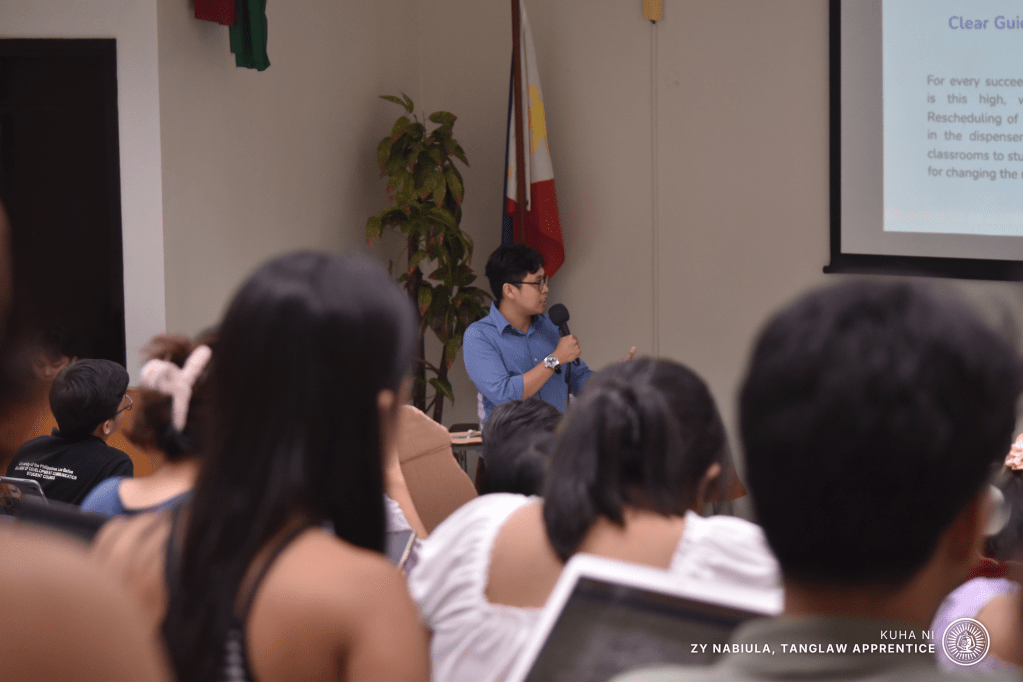
Isinagawa ang panayam kay Ethan Gavril Pahm sa loob ng CDC building noong Lunes, Abril 28.
INTERVIEW GUIDELINES
- Maaaring gawin ang panayam nang face-to-face o online, depende sa mapag-uusapan ng Tanglaw Editorial Board at nangangandidato
- Mayroong sampu (10) na tanong na ihaharap sa partido at independent na kandidato, at apat (4) na bukod na tanong patungkol sa karakter at mga isyu sa kada partido o independent na kandidato.
- Bibigyan ang bawat kandidato ng dalawang (2) minuto upang sagutin ang bawat tanong.
- Ang magiging sagot sa panayam ay pinal at hindi na kikilalanin ng pahayagan ang anumang paglilinaw matapos masagot ang isang tanong.
DAPAT MONG MALAMAN
Pindutin ang tanong upang dumiretso sa buong transcript ng naging sagot ng mga kandidato.
General Questions
Ayon kay Pahm, dahil raw umano sa budget cuts, walang sapat na pondo upang tugunan ang epekto ng mataas na heat index o makapagtayo ng mas komportableng pasilidad para sa mga estudyante. Wika niya, magsusulong siya ng malinaw na panuntunan para sa pagtugon ng kolehiyo tuwing may matinding init, tulad ng regular na suplay ng inuming tubig, pagbubukas ng mga silid-aralan nang hindi na kailangan ng hiling mula sa student council, at pag-adjust ng exams o klase. Dagdag niya, mahalaga ring buksan ang usapan sa mga faculty-in-charge ukol sa mode of class, at igiit ang pagtigil sa budget cuts upang makapagtayo ng mas maraming student-friendly spaces at matapos ang mga renovation sa Student Union Building.
Aniya’y malinaw na kulang sa kongkretong aksyon ang administrasyon ng UPLB kaugnay ng tumitinding init ng panahon at iba pang kalamidad. Aniya, bagama’t may environmental committee na naitatag kamakailan, hindi pa rin ito sapat kung hindi aktibong kikilos ang Unibersidad upang suportahan ang panawagan para sa climate justice at panagutin ang mga kumpanyang malaki ang ambag sa krisis sa klima. Dagdag pa niya, hindi lamang heat index ang isyu kundi pati na rin ang kawalan ng malinaw at agarang tugon ng pamunuan tuwing may sakuna, gaya noong Bagyong Kristine kung saan ang student councils pa raw umano ang kumilos upang matulungan ang mga stranded na dormer. Wika niya, kailangang maging mas maagap at handa ang administrasyon sa pagtugon sa mga ganitong sitwasyon na direktang nakaaapekto sa kapakanan ng mga estudyante.
Aniya, dahil sa mga budget cut, nagiging mahirap para sa mga estudyante, lalo na sa mga artist at sa mga organisasyon, ang magkaroon ng sapat na espasyo para sa kanilang mga aktibidad. Binanggit din niya na pati ang mga student council, o maski ang Tanglaw, ay wala ring angkop na opisina. Wika niya, isa sa kanyang mga layunin ay makipagtulungan sa University Student Council at Student Regent upang pigilan ang mga budget cut at tiyakin na may mga espasyong magagamit ang mga estudyante para sa kanilang mga aktibidad at organisasyon. Ipinahayag din niyang mahalaga para sa mga estudyante ang pagkakaroon ng pagkakataong mag-organisa at magsagawa ng mga aktibidad na hindi lang nakatuon sa pag-aaral.
Ayon kay Pahm, dapat suportahan ng Student Council ang Tanglaw bilang isang malaya at independent na publikasyon sa pamamagitan ng pagtanggap sa kanila bilang partner sa mga kaganapan, ngunit hindi bilang endorsement. Dapat din daw na isama ang Tanglaw sa mga consultation o town hall meeting upang mapanatili ang transparency at magbigay ng pagkakataon na mas mapalakas ang kanilang papel bilang opisyal na publikasyon ng kolehiyo. Aniya, mahalaga ring suportahan ang iba pang campus publications, tulad ng bagong CEM publication, upang magtaguyod ng isang network ng mga publikasyong nagbibigay ng transparency at nagtataguyod ng community media sa UPLB.
Ayon sa kaniya, kailangan daw umanong kilalanin ang disconnect sa pagitan ng interes ng mga estudyante at ng mga aktibidad ng Student Council. Isinusulong daw niya ang mas personal at on-ground na komunikasyon, tulad ng pagbabalik ng batch representative system, kung saan ang mga estudyante ay mas madaling makakonekta at makipag-ugnayan. Dapat din daw na madaling lapitan ang Student Council, sa pamamagitan ng ‘di gaanong pormal na mga talakayan at face-to-face interactions, imbes na magpokus lamang sa formal channels tulad ng Google Forms.
Ayon sa kaniya, mahalaga para sa CDC Student Council na gamitin ang kanilang koneksyon sa mga formal na channel, tulad ng mga pagpupulong ng University Student Council at General Assembly of Student Councils, upang makipag-alyansa sa iba pang kolehiyo. Dapat nilang unawain ang mga isyu ng bawat kolehiyo, tulad ng CVM at CFNR, at magsanib-puwersa upang itaguyod ang karapatan at kapakanan ng mga estudyante. Sa pamamagitan ng pagsasagawa ng mga maayos na pananaliksik sa mga pahayag at paggamit ng legislative processes, maaaring mapalakas ang kolektibong pagtutulungan para sa mga estudyante.
Binanggit ni Pahm na dapat magsimula sa grassroots level, kung saan ang Student Council ay makikinig sa mga estudyante upang malaman ang kanilang mga partikular na problema, tulad ng heat wave at kakulangan sa mga pasilidad. Mula rito, dapat magtulungan ang Student Council, UPLB admin, at LGU upang magtakda ng mga malinaw na guidelines at protocols, pati na rin tiyakin na ang mga policies ay ipatutupad upang matugunan ang mga pangangailangan ng mga estudyante.
Aniya ang susi raw upang matiyak na ang mga panawagan ng mga estudyante ay maisasakatuparan ay ang transparency at konsultasyon. Dapat magkaroon ng regular na pakikipag-ugnayan sa mga estudyante upang malaman ang kanilang mga pangangailangan, pati na rin ang pagpapalabas ng mga pormal na ulat sa progreso at transparency reports. Sa ganitong paraan, matutulungan ang Student Council na manatiling accountable at tinitiyak na ang mga pangako ay natutugunan sa loob ng mga kakayahan at mga resources na mayroon sila.
Nakita ni Pahm ang papel ng Student Council sa pagtutok sa mga isyu ng komersyalisasyon sa campus. Dapat gamitin ng Student Council ang kanilang koneksyon sa USC upang magsagawa ng mga pahayag na nagpapakita ng mga isyu ng mataas na presyo ng pagkain, dorms, at amenities. Isa sa mga halimbawa ay ang pagsusulong na ang mga lokal na karenderya ay makapuno ng mga espasyo sa SU Building kaysa sa mga fast food chain. Bilang media production students, tinukoy din ni Pahm ang kakulangan ng mga studio at ang epekto ng budget cuts sa kalidad ng edukasyon. Sa pamamagitan ng mga pahayag at kooperasyon sa administrasyon, layunin nilang makamit ang mas accessible na mga serbisyo para sa mga estudyante.
Nais niyang tutukan ang malawak at makabuluhang partisipasyon ng mga estudyante sa rebisyon ng Bachelor of Science in Development Communicatiopn curriculum. Bilang kasalukuyang kinatawan daw sa Curriculum Committee, nakita niya ang halaga ng tunay na representasyon ng bawat batch sa paghubog ng kurikulum. Para sa kanya, mahalagang marinig ang iba’t ibang pananaw ng mga batch dahil magkakaiba ang kanilang karanasan sa mga kursong DEVC, mula sa kakulangan ng sustainability sa mga partner hanggang sa personal na mga danas sa kabigatan ng DEVC 136. Sa pamamagitan ng pormal at di-pormal na konsultasyon, layunin daw niyang gawing mas angkop, makatao, at epektibo ang kurikulum para sa bawat Devcom student.
Mga tanong para sa kandidato (Independent)
Wika ni Pahm na sisiguraduhin niyang magiging participatory at consultative ang kanyang termino sa pamamagitan ng reorientation at reimplementation ng batch representative system. Aniya, lilimitahan ang gawain ng batch representatives sa pagiging miyembro lamang ng isang komite upang makapokus sila sa pagkuha ng mga sentimyento ng kanilang batch, sa halip na gampanan ang mabibigat na tungkulin ng isang councilor. Dagdag pa niya, magbibigay siya ng mas malaking diin sa impormal na komunikasyon, bukod sa pormal na Council of Student Leaders, upang mas direkta at tapat na marinig ang mga hinaing ng mga estudyante dahil hindi raw lahat ng sentimyento ay kayang maipahayag sa pormal na survey o Google Forms lamang.
Wika ng kandidato, nais niyang tuluyang alisin ang agwat sa pagitan ng student council at ng mga estudyante sa pamamagitan ng revised batch representative system at mas grassroots na approach sa konsultasyon. Aniya, hindi sapat ang paglalabas lamang ng Google Forms, dapat aktibong lumapit ang konseho sa mga estudyante, makipag-ugnayan sa mga organisasyon, at makipag-usap mismo sa mga estudyante sa mga pasilyo. Dagdag niya, responsibilidad ng konseho ang makinig at magpakonsulta at palagiang dumalo sa mga pormal na pagtitipon tulad ng CSLs.
Ani Pahm, balak niya raw isulong ang makataong academic policies at mental health initiatives sa dalawang paraan: una, sa pamamagitan ng pagpapalawak ng access sa mental health programs hindi lang sa loob ng UPLB kundi pati na rin sa buong UP System. Aniya, dahil sa kakulangan sa pondo at burukrasya, nagiging hindi accessible ang serbisyo ng OSA at University Health Service, kaya’t mahalagang maghanap ng alternatibong koneksyon tulad ng online counseling mula sa ibang constituent units ng UP. Ikalawa, isinusulong niya ang masinsinang konsultasyon sa mga estudyante upang mapagaan ang curriculum nang hindi isinasakripisyo ang kalidad ng edukasyon, at sa halip ay mas mailapat ito sa tunay na pangangailangan at kakayahan ng mga mag-aaral.
Ayon kay Pahm, makikita raw ang tunay na pagtataguyod ng interes ng mga estudyante sa pamamagitan ng konkretong resulta gaya ng regular na transparency reports at matagumpay na mga konsultasyon at deliberasyon kaugnay ng curriculum changes. Aniya, bilang isang resource-oriented na tao, layunin niyang maging batayan ng tagumpay ang positibong tugon ng mga estudyante at ang makabuluhang pagbabago sa mga polisiyang pang-akademiko na tunay na lapat sa kanilang pangangailangan.
TRANSCRIPT NG PANAYAM
GENERAL QUESTIONS
PAHM: With regard to problems such as the high heat index and the lack of student-friendly spaces, it’s ultimately, the root cause is because of the very continuous na budget cut na year after year, nagkakaroon ng budget cut ang ating kolehiyo. And how that affects us is, wala tayong budget in order to build more student-friendly spaces. So, UP itself has to resort to commercialization, where, if you notice around the LB area, there’s more and more cafes popping up. Parang every week, there’s a new cafe that pops up. And then, with regard to the heat index, there’s no budget to be able to handle this heat index properly na confusing yung idea of being able to shift the mode of classes, for one, or even have the proper facilities to house students in the context of a high heat index.
Ang magagawa ko as your next CDCSC chairperson is really, for the context of heat index, is to have concrete and solid guidelines of what the college will do and hopefully what the university might be able to do in the future on what we do in times of high heat index. For example, being able to have a set amount of budget so that there’s always water in our water dispenser. Being able to automatically open the classrooms already like this, hindi na kailangang magtanong ng student councils and hopefully magagawa rin ‘yun ng university. Also, furthermore, is to be able to move classes, to be able to move exams because students can’t study and can’t take exams kapag mainit. And then finally, to be able to open discussion with FICs for the mode of class kasi that’s also their academic right, not to be hampered by the schedule. But with regard to student-friendly study spaces, we really need to be able to amplify the call na for once, ‘wag sana i-cut yung budget ng UP para makapag establish ng more friendly study spaces, furthermore than just the outside or using unused classrooms and hopefully be able to finish the renovations from SU para mas may accessible na student space na gamiting ng mga students. (Pindutin ito upang makabalik sa “dapat mong malaman”)
PAHM:I don’t really need to think about that because it’s very linked to my previous. Ayun, my opinion with regard to the current problem, the high heat index and the response of the admin of UPLB because what exactly is the root of our cause, the heat index? Ultimately, it’s an environmental problem. And that’s something that the admin of UPLB has not yet been really focused on. Once upon a time, we were the prime agricultural college and to the extent, environmental rin. But a lot of the time, we barely see the admin releasing any statements or any sort of solid steps in order to amplify mga calls talaga ng environmental sector natin to address this. One of the things that I put in my GPOA is to be able to maximize ‘yung recently established environmental committee ng incumbent term in order to be able to partner with external and internal organizations to amplify the call for better climate justice against itong mga big companies who love to pollute and ultimately raise our heat index dito sa Pinas.
But aside from that, with concern to students, I think I mentioned being able to have very specific and clear guidelines kasi gano’n rin eh, not only is it the heat index but also naaapektuhan yung mga guidelines and protocols natin tuwing times ng bagyo. For example, noong bagyong Kristine, the admin does not have a solid response. Rather, it had to be coming from the students and student council, ‘yung serve the people brigade to be able to address yung mga problema ng students in order to get ‘yung mga dormers na nastranded, food, or even have to consider paano makakauwi yung mga ilang dormers dito. There’s no budget set aside to be able to give them an opportunity to ferry them using a car or transport of some sort for them to be able to go back to their respective provinces.
So overall, I’m thinking that the administration has been very lacking in terms of how proactive they are with regard to treating environmental disasters and in general, ‘yung mga things that affect students and our university. (Pindutin ito upang makabalik sa “dapat mong malaman”)
PAHM: With regard to the lack of our student spaces, I think I mentioned in one of the previous questions that it’s kind of an issue of the constant budget cuts sa atin where we don’t have enough money to be able to build our proper student spaces for our student artists or activities. And if I’m correct, even yung student council even ‘yung Tanglaw now do not have a proper office, in our case, the student council, our office is right next to the bathroom under the SCICOM stairs, hindi naman under, katabi lang non. And one of the things that I myself would be doing, including the student council, is really to be able to work with the univ wide student council. Because ultimately, because of these budget cuts, the admin is forced to commercialize and leave it to all these other establishments who are setting up cafes. And they call it “okay na ‘yan, may spaces na sila dahil sa mga cafes na ito.”
But ultimately, these are not accessible to students because they still have to pay for the coffee. They still have to pay for expensive coffee like this. And the very fact that we have a Starbucks right outside a UP campus is very indicative yung naging stance nila of “okay na ‘yan” with regard to student spaces. So, the student council should be working closely with the university student council. And ultimately, at some point, the student regent hopefully, in order to push na huwag sana ulit i-cut yung budget ng UP. So that students have student spaces they can use to organize.
Because ayun nga, it’s really our democratic right as students to be able to organize and be able to have activities that aren’t just studying. Ayun nga naman. Another thing that I guess I could add is that as a result of this commercialization and budget cut, we have to resort to things like, I’m sure you’ve seen the vending machines that are there downstairs. That’s also a result of that. And I’m hoping that the administration can push for alternatives to having our budget cut, but also alternatives to these commercialization methods where the inside of our campus gets more and more commercialized. (Pindutin ito upang makabalik sa “dapat mong malaman”)
PAHM:I think I have an answer already. With the process of Tanglaw to being institutionalized by the admin, I think I speak here from personal experience because I’m also a former member of UPLB Perspective before I ran.
One of the things that the Student Council can really do is to recognize the right of Tanglaw as an independent media organization or campus publication by constantly being able to support ‘yung mga events nila through also offering our partnership, but of course not endorsement because it’s really of the press. And pag nakakaroon ng mga CSL or town hall or consultations ‘yung mga students, we would always be able to openly invite Tanglaw to cover it because on the other hand, that keeps us transparent in the sense that it keeps us sure na itong ginagawa ng mga activities ng mga Student Council. But at the same time, it also helps recognize Tanglaw as our college publication.
And I think furthermore, nakasabi naman talaga ito sa GPOA ko na as long with being able to support Tanglaw for the activities, I think the Student Council should also be able to show support for other college publications like the newly established CEM publication for one, so that there is this network of campus publications that really ensures transparency and as much as possible, reinforcing the idea of community media inside UPLB. (Pindutin ito upang makabalik sa “dapat mong malaman”)
PAHM: Okay, with regard to the very low student participation, I think one of the root causes is that students do not feel inclined to participate with the democratic process of the Student Council, because as with previous terms, and I’ve something I’ve experienced this as an incumbent, is that we need to recognize, and I think this is also something I said during the consultations, is that there is an inherent disconnect at the moment with the interests of the student body and what the activities are of the Student Council. I remember from one consultation, it’s that there
are many sentiments where it often feels like the Student Council is simply the mouthpiece of the administration, when in fact, it should be the opposite. What the Student Council should be doing is rather being the mouthpiece of the students.
So, one thing that we can do is, because in comparison to current systems where we have CSL, that’s the Council of Student Leaders, where it’s open on paper, open naman talaga siya for anyone to join, it still feels inaccessible because it feels like a big thing. In order to attend, you need to somewhat have knowledge of the parliamentary procedure. I think one thing we can do is a shift in attitude instead of it being one time big thing, tiny thing, formal event. I think especially as Devcom students, we can emphasize the informal communication and non-formal communication, na mas on-ground ‘yung approach. That’s why it said in my GPOA. That’s why I would rather, ‘di naman rather, but instead, I would be able to re-implement, in a way, the batch rep system where we’re much more connected on the on-ground. And once we resolve the issues there, for more formal issues and really getting everybody on board, that’s when we have the CSL.
But the priority is really on-ground interpersonal communication, face-to-face, having informal discussions along the hallway, and being able to just simply talk to students and making the council appear more approachable, considering that previously, a lot of the time, for example, this issue with the Freedom Wall, there’s a lot of people using it too. But I don’t really like the word black prop, so per se, I think that’s the formal term that we use. It also shows that there’s a disconnect between the student council and students, in the sense that students don’t feel comfortable raising their issues directly to the council using the formal channels. And it means that the student council really needs to adopt a different kind of practice with regard to how we interact with the students, not just through Google Forms, but really through face-to-face and talking to students in formal communication. (Pindutin ito upang makabalik sa “dapat mong malaman”)
PAHM: Okay, so, us, the CDC Student Council, I think we’re quite fortunate that we have a lot of voting power with the many committees of the administration. I myself am part of the curriculum committee for the curriculum changes, and I did a lot of consultations for that. However, we need to recognize that other colleges might not have as good of a relationship with their administration.
And I think, as the CDC Student Council, our role there is really to utilize ‘yung mga formal channels with other colleges, katulad ng college representative to the USC, but also mga pagpupulong such as univ wide CSL, the GASC, the General Assembly of Student Councils, and the All Student Councils Assembly Meeting, to really find opportunities for us to understand also the constituents of other colleges and form alliances with them in order for them to really champion the interests and sentiments of their students as well. We can also work with them to be able to release our own statements, kasi hindi naman tayo isolated, tayong CDC. And we can work with the University Student Council to help in our own ways because at the end of the day, we are a different college. We don’t know the issues as well as they do. So ultimately, what we should be doing is to extend the hand and understand the issue depending on the point of view of that certain college. So we work with CVM-SC to be able to understand CVM students or CFNR-SC to understand CFNR students para mas maging participatory ‘yung maging approach natin through releasing statements that are well-researched and using the legislative processes such as the CSL but also the Student Legislative Chamber to release policies that are really well-researched and participatory in the interests of students. (Pindutin ito upang makabalik sa “dapat mong malaman”)
PAHM: So with the role of the Student Council, we need to take, like I said many times, you are a participatory approach. We really need to start at the grassroots level. And that means talking to students. Na it’s easy to see from a point of view of being Student Council, oh, we need to do this, we need to do that. But ultimately, what we need to be doing is talking to students and ask them what exactly are their specific difficulties with regard to dealing with things like the heat wave and with the context of having difficulties with their basic facilities. And then from there, be able to work with the UPLB admin. Like I said, having a proactive and set upon set of guidelines and protocols.
Anong gagawin in times of high heat index? And I remember just a week ago is that the LGU did release a memo with regard to being able to cancel classes. But many students were confused. The next day, I had many people tell me, I thought classes were canceled when the fact of the matter was that it was really up to the FIC whether they were available to cancel classes or not. Ayan, that’s the way we bridge the gap. It’s that we get the interest of the student body first, be able to craft policy and procedure with the UPLB admin, and work with the LGU na talagang makikita rin nila na yung big region-wide protocols nila is also applied to the UPLP admin para ma-apply rin sa mga things that is going to be implemented supposedly for the students. (Pindutin ito upang makabalik sa “dapat mong malaman”)
PAHM: Ultimately with regard to making sure that our plans, our campaigns become concrete. For me, I think it’s a matter of transparency. I can go up to the MTA later and say, this is what I want to do, these are the campaigns I want to push.
But at the end of the day, what would it all be for if I don’t actually accomplish any of them? For example, I know that one of the criticisms is that a lot of the things that I mentioned during my GPOA when I ran as college representative, parang medyo nakukulang yung mga ilan sa being able to see concrete action from that. I think I’ve learned from that experience since and it’s that transparency that’s really necessary. So what the student councils can do to ensure transparency and make sure that we’re always on the right track is twofold.
One of them is to be able to adopt a very consultative nature na always being able to talk to students like what I said earlier but also being able to release formal transparency reports and progress reports. At least a good idea would be monthly para makikita talaga ng tao na this is what we do. And on the side of the council, yun nga technically, mapapressure rin kami to be able to follow up on what we promised as realistically as possible and within the bounds of what we can do to maximize our position sa admin and the resources that we need to be able leverage. (Pindutin ito upang makabalik sa “dapat mong malaman”)
PAHM: So, with regard to the high cost of living and well, high cost of actually studying, it’s really a question of whether our UP education is really free when yung jeepney, the price of taking a jeep has increased, the price of food has increased, the price of dorms have increased. Believe me, I know that one as someone who’s still looking. I think that the role really of the Student Council is to find the root of the issue, which is, of course, commercialization. As I said, na commercialization of our campus where a lot of the amenities that are supposed to be accessible to us as students, for example, food, drinks, facilities, places to study, are ultimately getting more and more filled out by, well, commercial means. For example, yung cafes, more fast food chains, for example. And our role as Student Council is to be able to utilize our position with connection to the University Student Council to push for the admin, instead of having fast food chains inside, instead of having a Chooks To Go, why not have one of the local karenderya be able to fill out the positions in SU, as an example. But also release well-researched statements that help students understand na this should not be the status quo.
Instead of us having to always rely on expensive food, expensive dorm, dapat talaga with our free UP education, as the premier state university of the Philippines, dapat we should be well taken care of by the UPLB admin. Our dorm should be accessible, for one. Like I said, yung example sa food, but also we should have better amenities in general. And with regard to yung pagiging media production students, I’m sure one of the issues that I consulted upon, specifically sa DEVC 30, is that there’s only one studio. And sometimes students taking DEVC 30 don’t even get to go home on time because their schedule for media broadcast overlaps with the weekend already. And that’s a result, ultimately, of the budget cut. (Pindutin ito upang makabalik sa “dapat mong malaman”)
And us as a Student Council need to leverage our position to release statements and push the admin, in collaboration with the USC, to push na huwag sana, again, i-cut yung budget ng UP.
PAHM: Okay. The number one, I wouldn’t really call it an issue, but rather something that’s ongoing, is that I think I mentioned previously that I’m part of the Curriculum Committee of the Administration. And I think this is a big thing moving forward. I think during our 155 class, some of the consultation for students were really limited to room-to-room with the members of the Student Council. However, I’ve always felt that this was limited, in the sense that each DEVCOM batch deserves to have their own voice because they have their own unique insight. Ito yung naging curriculum of our BSDC curriculum, na someone from batch 22 might have a different insight from someone who’s batch 23 or batch 24. And that’s why number one on my GPOA was really to be able to have extensive consultations, both formal and informal, and database, so that we can really choose the next direction of our BSDC curriculum.
Because to me, that’s what actually one of the biggest things that inspired me to run. Because when I took on the role of Curriculum Committee Student Rep, that’s what I found to be one of the best examples of genuine student representation.
It’s rare to see students having such a big role and such a big say in being able to shape and mold our own curriculum. Since who better to understand the problems of the curriculum than DEVCOM students themselves? We’ve had so many people give us so much feedback na yung mga broad courses don’t have sustainability with our partners. DEVC 136 is too heavy of a class for it to just be three units. The DEVC series is often very overwhelming for how early it is into the curriculum. And I think that I’d really love to be able to champion talaga each and every sentiment of every DEVCOM student so that we can build a better BSDC curriculum together and as a DEVCOM whole. (Pindutin ito upang makabalik sa “dapat mong malaman”)
Mga tanong para sa kandidato (Independent)
PAHM: Being able to ensure that my term is participatory and consultative, I think I said in my GPOA na, yung reorientation and reimplementation of the Batch Rep system. Just a bit of context. Previously, many people were adverse to the Batch Rep system and that they did not want to be appointed as Batch Rep or did not want to run as Batch Rep because, let’s face it, a lot of people see the Batch Rep or ex officio, they see it as a lot of difficult work, parang naging councillor ka na rin without being elected.
But one of the things that I plan to do with the Batch Rep system is to be able to focus its scope in a way na allows them to do their job, na more focused to the name itself by making them members only of committee, hindi sila mag head ng committee ng committe ng council. and also maglilimit lang sila to one committee so that their work can really be focused on gathering the sentiments of their batch in order for us to be participatory, you know, the grassroots level, matatanong talaga natin student per student. I also mentioned a renewed focus on being able to have more informal communication rather than simply having CSLs.
During the current, previous, well during my term, our CSLs were not as frequent as we’d like to be, that’s why I think that we could improve how connected we are to the Devcom community. And I think that including having more CSLs, that renewed focus on informal communication is one of the best ways to make my upcoming term participatory and consultative para makuha rin talaga yung true sentiments ng mga students, not in a formal sense because often times it’s hard to say the sentiments if it’s always so formal, if it’s always through Google Forms. There is a place for data-based feedback, but when we’re dealing with students and student issues that impact them personally, I think it needs to be two-fold, both through data and through, well, qualitative in the sense that kinakausap namin ‘yung mga estudyante. (Pindutin ito upang makabalik sa “dapat mong malaman”)
PAHM: I think that this question is a little bit overlapping with the one I previously mentioned. Pero to summarize, it’s through the revised Batch Rep system as well as a better approach that is more grassroots and informal alongside the release of Google Forms in order to really get the opinions and sentiments of students. And I think one of the things is really an attitude of change that instead of simply thinking that we can release Google Forms, we really need to make more of an effort to go out and talk to students, go out and consult orgs, find opportunities na magpaalam to heads of these orgs para mag consult sa mga GA nila that hopefully be able to afford us that much of their time.
But also, talking to students in the hallway, being able to utilize the Batch Reps, it should be much more than simply just “attend kayo ng CSL” because the burden of attending the CSL should not be on students to go and get themselves informed, but the burden should be on the Student Council to approach the students and understand their side as much as possible. (Pindutin ito upang makabalik sa “dapat mong malaman”)
PAHM: Okay, so with regard, I think I can answer this question in twofold. First of all, it’s with regard to mental health initiatives. From consultations, there have been people who come to us saying that, of course, they feel that the Office of Student Counseling and Guidance is often, how would I put it? It’s not exactly ineffective, but it’s not very accessible for students because it’s still quite a bureaucratic process. And the same goes for the mental health programs of UHS.
I think that these two are so bureaucratic and so inaccessibly so because, there’s so many students dealing with so many mental health struggles because of the low budget and constant budget cuts. Both of these institutions cannot really keep up. I think one of the things that hasn’t been done before, but something that we can do moving forward, is to be able to connect students to mental health programs, not just inside UPLB, but also to the UP system as a whole.
Because I, myself, in my first few years back in 2020, my counselor came from UP Diliman, online. And while, of course, an online counselor isn’t ideal, I think it’s still a good start to be able to get more accessibility of mental health programs for students. And then second of all, one of the struggles of academic burnout is because minsan mabigat talaga yung curriculum. And that’s one of the things I want to do. That’s why we get as many consultations as possible from students in order to make the balance between how much they learn and how much workload they have, something more balanced. We can be able to utilize these extensive consultations in order to build a more healthy and a better BSDC curriculum moving forward. So that regardless of if it’s a heavy workload or not, students will feel more fulfilled knowing that their curriculum is very much tailored to their needs and to their capabilities and skills na kailangan talaga nila. (Pindutin ito upang makabalik sa “dapat mong malaman”)
PAHM: For me, I think that on a personal level, I’m a very resource-oriented person. And from the way I see, if we really were able to champion the interests of the students, it’s through the transparency reports that we’ll hopefully be able to release monthly. If we’re really right on track, and if through the way we talk to students and maganda naman yung mga sentiments nila, I think that will show that we’re doing the right thing. That we’re on the right track. That we’re really championing the interests of the students. And once matapos yung curriculum changes, and as much as possible, nagging matagumpay ang amin discussions with the admin and deliberations with how to change the curriculum, I think that will be the result that we’re looking for. And that will be the concrete, tangible change that hopefully will appear once my term is finished, or even through the midway point of the term. (Pindutin ito upang makabalik sa “dapat mong malaman”)
 Tanglaw